The Emotional Battle in Investing
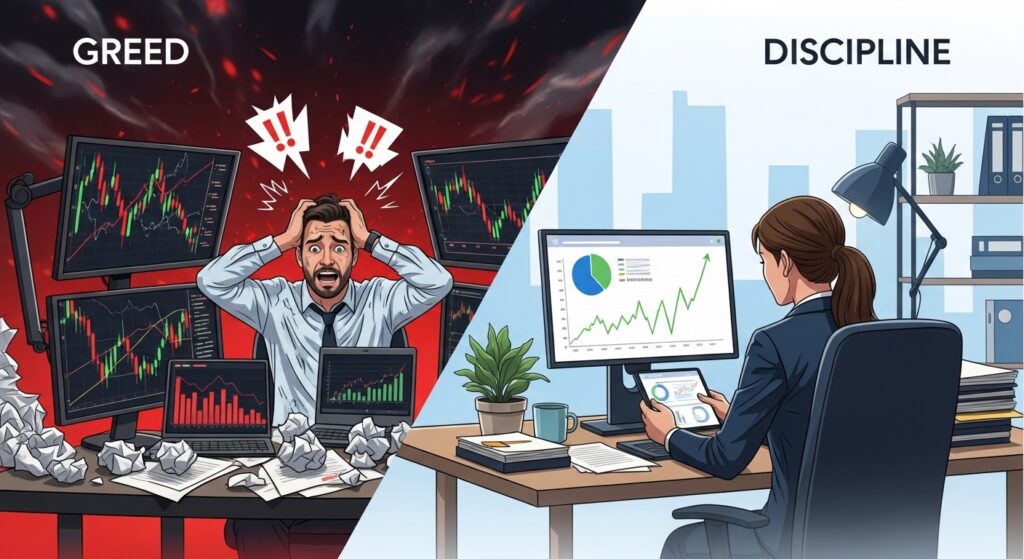
Greed vs. discipline in investing is one of the most important concepts every investor must understand. Investing is not just about numbers, charts, or financial statements—it’s deeply emotional. Investing is not just about numbers, charts, or financial statements; it’s deeply emotional. Every decision you make, whether to buy, hold, or sell, is influenced by how you feel at that moment. Among all emotions, two dominate the investing world: greed and discipline.
Greed pushes investors toward quick profits and risky opportunities, often ignoring long-term consequences. Discipline, on the other hand, keeps you focused on your strategy, even during market volatility.
Understanding and balancing greed vs. discipline in investing can be the difference between building sustainable wealth and making costly mistakes. Successful investors are not those who eliminate emotions but those who manage them effectively.

Greed vs Discipline in Investing: Understanding Greed
Greed is the intense desire to earn more money quickly, often leading to impulsive and irrational decisions. In the financial markets, greed can be extremely dangerous because it pushes investors to ignore logic and chase unrealistic returns. Instead of following a structured strategy, greedy investors are often driven by emotions, which increases the chances of making costly mistakes.
Understanding greed vs discipline in investing is crucial because greed usually appears strongest during bullish market conditions. When prices are rising and everyone seems to be making profits, investors feel pressure to jump in without proper analysis. This creates a cycle where decisions are based on excitement rather than data.
Common Signs of Greed:
Chasing high-risk stocks for quick gains
Ignoring diversification principles
Overtrading during bullish markets
Investing based on hype or trends
These behaviors might deliver short-term gains, but they often lead to long-term losses. Greed makes investors believe they can consistently beat the market, which is rarely true.
Investors driven by greed often fall into the trap of “get rich quick” thinking. They focus heavily on short-term profits instead of building sustainable wealth over time. As a result, they take unnecessary risks, ignore warning signs, and fail to prepare for market downturns.
Key Traits of Greedy Investors:
Emotional reactions to market news
Overconfidence in predicting trends
Ignoring risk management strategies
Lack of patience and discipline
Another important aspect of greed vs discipline in investing is how it affects decision-making under pressure. Greedy investors often buy assets at peak prices due to fear of missing out (FOMO), and when the market corrects, they panic and sell at a loss.
When markets are rising, greed makes everything look easy and profitable. However, this illusion can be dangerous. Once the trend reverses, losses can be severe and sudden. This is why controlling greed is essential for long-term investing success.
Mastering greed vs discipline in investing helps you stay focused on your goals, avoid emotional decisions, and build a more stable financial future.

Greed vs. Discipline in Investing: What is Discipline?
Discipline in investing means sticking to a plan regardless of emotions or market noise. It is the foundation of long-term financial success.
A disciplined investor:
- Maintains a diversified portfolio
- Follows a long-term strategy
- Applies consistent risk management
- Avoids emotional decision-making
Discipline acts like a compass; it keeps you on track even when markets fluctuate. Instead of reacting impulsively, disciplined investors rely on data, planning, and a patient approach.
Greed vs. discipline in investing is essential for long-term success.
Understanding greed vs. discipline in investing helps avoid costly mistakes.
Mastering greed vs discipline in investing improves decision-making.
Over time, discipline leads to compounding growth, which is the real secret behind wealth creation. Greed vs. discipline in investing plays a crucial role during market volatility.
The Effects of Greed on Your Portfolio
Greed can significantly damage your financial health. While it may yield short-term benefits, the long-term consequences are often detrimental.
Major Impacts:
- Increased volatility: Risky investments lead to unstable returns
- Poor decision-making: Emotions override logic
- Portfolio imbalance: Overexposure to trending assets
For example, during hype-driven market events, many investors jump in late due to greed and end up buying at peak prices. When the market corrects, they face heavy losses.
Greed makes you forget one simple rule: the market rewards patience, not impulsiveness.
The Science Behind Investing Behavior
Your brain plays a huge role in your investing decisions. Understanding this can help you gain better control.
Psychological Factors:
- Amygdala activation: Triggers fear and greed responses
- Dopamine release: Winning trades create addictive behavior
- Cognitive biases: Overconfidence and herd mentality
These biological and psychological triggers explain why many investors struggle to stay disciplined.
The key is awareness. Once you understand how your brain works, you can design systems that reduce emotional interference.
Practical Tips to Cultivate Discipline
Most people rely on willpower—but that’s not enough. Instead, use structured strategies:
1. Set Clear Goals
Define your financial objectives:
- Short-term (1–3 years)
- Long-term (5–20 years)
2. Automate Investments
Use systematic investment plans (SIPs) to remove emotional decisions.
3. Track Your Portfolio
Review weekly—not daily—to avoid overreacting.
4. Use Stop-Loss Orders
Protect your capital by limiting potential losses.
5. Follow Rule-Based Strategies
Predefine entry and exit points before investing.
Pro Tip:
Maintain a trading journal to track decisions and emotional triggers. This helps improve future performance.
Lifestyle and Mindset Habits for Investors
Discipline is not just financial—it’s personal.
Build Strong Habits:
- Start your day by reviewing financial news objectively
- Avoid social media hype about “hot stocks.”
- Practice mindfulness or meditation
- Invest only what fits your budget
Think of your portfolio like a garden:
- Discipline = consistent watering
- Greed is trying to force growth overnight
Long-term success comes from consistency, not intensity.
Common Myths About Investing
Let’s clear some common misconceptions:
Myth 1: Fast profits = smart investing
Reality: Long-term investing outperforms short-term trading.
Myth 2: More trades = more profit
Reality: Overtrading increases transaction costs and losses.
Myth 3: Risk is bad
Reality: Managed risk is essential for growth.
Understanding these myths helps you avoid emotional traps and stay disciplined.
Beginner Mistakes to Avoid
New investors often make predictable errors:
- Following tips without research
- Ignoring asset allocation
- Reacting emotionally to news
- Investing without an exit plan
- Lack of diversification
Avoiding these mistakes can significantly improve your chances of success.
Actionable Weekly Investor Plan
Consistency is key. Follow this simple weekly structure:
- Monday: Review portfolio and market updates
- Tuesday: Research new opportunities
- Wednesday: Reflect on past decisions
- Thursday: Adjust based on strategy
- Friday: Update trading journal
- Weekend: Learn and improve knowledge
Small, consistent actions lead to big, long-term results.
Safety and Risk Management
Risk management is essential for survival in investing.
Key Strategies:
- Diversify across asset classes
- Set stop-loss levels
- Avoid excessive leverage
- Maintain an emergency fund (3–6 months)
Discipline in risk management protects your capital during downturns and ensures long-term stability.
Greed vs Discipline in Investing: Key Differences Explained
Understanding greed vs discipline in investing becomes easier when you clearly see the difference between the two approaches. Greedy investors often focus on short-term gains and emotional decisions, while disciplined investors follow a structured plan and think long-term.
Greed vs discipline in investing plays a critical role in how you react to market changes. The ability to stay calm and stick to a strategy is what separates successful investors from those who struggle.
Greed vs Discipline: A Comparison
| Feature | Greed-Driven Investing | Disciplined Investing |
|---|---|---|
| Decision-Making | Emotional | Analytical |
| Risk Management | Ignored | Structured |
| Market Reaction | Panic/Hype | Calm |
| Growth | Unstable | Consistent |
| Emotional Control | Low | High |
This comparison clearly shows why discipline wins in the long run.
Real-World Case Studies
1. Market Bubbles
Investors driven by greed often enter markets late and exit with losses.
2. Long-Term Investors
Disciplined investors who stay invested and diversified tend to recover and grow wealth.
3. Market Crashes
Panic selling leads to losses, while disciplined investing benefits from recovery.
Many successful investors focus on mastering greed vs discipline in investing to achieve consistent results.
FAQ: Greed vs Discipline in Investing
Q1: What is greed in investing?
Greed is the desire for quick profits without a proper strategy.
Q2: What is discipline in investing?
It is sticking to a long-term plan despite market fluctuations.
Q3: How can I control emotions?
Use rules, automation, and a trading journal.
Q4: Is risk bad?
No, unmanaged risk is bad—controlled risk is necessary.
Q5: Can discipline improve returns?
Yes, it enhances consistency and compounding growth.
Conclusion: Building Long-Term Wealth
Mastering greed vs. discipline in investing is not about eliminating ambition—it’s about controlling it. Greed leads to impulsive decisions, while discipline builds sustainable success.
By understanding investing psychology, building strong habits, and following structured strategies, you can create long-term wealth.
Remember:
Investing is a marathon, not a sprint. Slow, steady, and disciplined always wins.
External Resources:
- Harvard Business Review https://hbr.org
- Investopedia https://www.investopedia.com
- FINRA https://www.finra.org
One comment on “Greed vs Discipline in Investing: 7 Proven Strategies to Control Emotions and Build Wealth”